
“While 93% of sales conversations focus on product features and pricing, the top 1% of sales professionals spend 80% of their time understanding human motivations, building trust, and creating genuine value for their clients, and they consistently outperform their peers by 300% in revenue generation.”
The modern B2B sales landscape is complex. Buyers involve more stakeholders, decision cycles stretch longer, and expectations are higher than ever. Yet, what separates good salespeople from exceptional ones is not just product knowledge or pricing strategy. It is their ability to make every interaction feel deeply human.
At Groval Eulers, we refer to this journey as Connect–Understand–Value–Appreciate (CUVA). Think of it not as a rigid framework, but as the natural rhythm of a sales conversation that transforms a transaction into a trusted partnership.
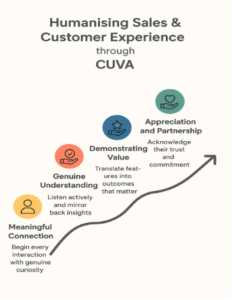
The First Step: Connection that feels Real
Every meaningful client relationship begins with connection. Not the surface-level LinkedIn invite, but the type that makes a client think: “This person gets my world.”
How to build it:
- Arrive with industry knowledge, not generic questions.
- Personalise openings with relevant insights or trends.
- Adjust to the client’s preferred communication style data vs. vision.
- Find authentic common ground (challenges, goals, or professional experiences).
- Follow through on small commitments to build credibility.
Going Deeper: Understanding beyond the obvious
Most salespeople stop at identifying pain points. Exceptional ones go deeper into context, motivations, and stakes.
Ways to deepen understanding:
- Ask layered questions that uncover why problems exist, not just what they are.
- Practice active listening. Notice what’s emphasised, avoided, or repeated.
- Recognise different stakeholder perspectives (operations vs. executives).
- Identify personal and career risks for decision-makers.
- Pay attention to cultural or political factors influencing adoption.
The Turning Point: Showing value that matters
Value is about impact. The shift comes when solutions are framed in terms that matter to the client’s world.
Ways to demonstrate value:
- Quantify benefits (e.g., “reduce processing time by 40%” instead of “increase efficiency”).
- Highlight multiple dimensions of value like financial, operational, strategic, risk reduction.
- Tailor messages for each stakeholder group.
- Be transparent about implementation realities such as timelines, integration, change management.
- Use proof points like case studies, client stories, relevant data.
The Long Game: Appreciation that builds Loyalty
Appreciation goes beyond polite thank-yous. It is about making clients feel respected, acknowledged, and celebrated.
Ways to show appreciation:
- Recognise their expertise and knowledge.
- Value their time spent on alignment and evaluation.
- Respect existing systems and past decisions.
- Celebrate their achievements and contributions.
- Position yourself as a collaborative partner, not just a vendor.
A Quick Self-Check for Sales Teams
Ask yourself:
- Did I prepare enough to create genuine connection?
- Did I uncover deeper motivations beyond surface pain points?
- Did I translate features into measurable, stakeholder-relevant value?
- Did I leave the client feeling respected and appreciated?
Elevating Sales through Human Experience:
CUVA is not just a method, it is a mindset. It turns conversations into trust-building moments, proposals into value-creation dialogues, and deals into partnerships.
Yes, it might slow down the early cycle, but it speeds up trust, reputation, and long-term growth.
If this resonates with your current sales challenges, I would love to hear your thoughts. Reach out to me at [email protected]
Explore more resources on consultative selling, account management culture, and B2B sales leadership at Groval Eulers.
