A decade ago, salespeople were valued because they had information.
Today, buyers can access information faster than ever.
They can compare vendors, read reviews, watch demos, speak to peers, and even ask AI to summarize an entire market in seconds.
Yet something interesting has happened.
As information has become easier to access, decision-making has become harder.
One of the patterns we consistently observe at Groval Eulers is that buyers rarely struggle to understand their options. They struggle to feel confident about their choice.
This is a critical shift. In a world where information is everywhere, sales can’t just be about providing data. It has to be about helping buyers decide with confidence.
The question is no longer, “What do I know that the buyer doesn’t?”
The question is, “What can I help the buyer see that they cannot see alone?”
The Modern B2B Sales Value Pyramid:
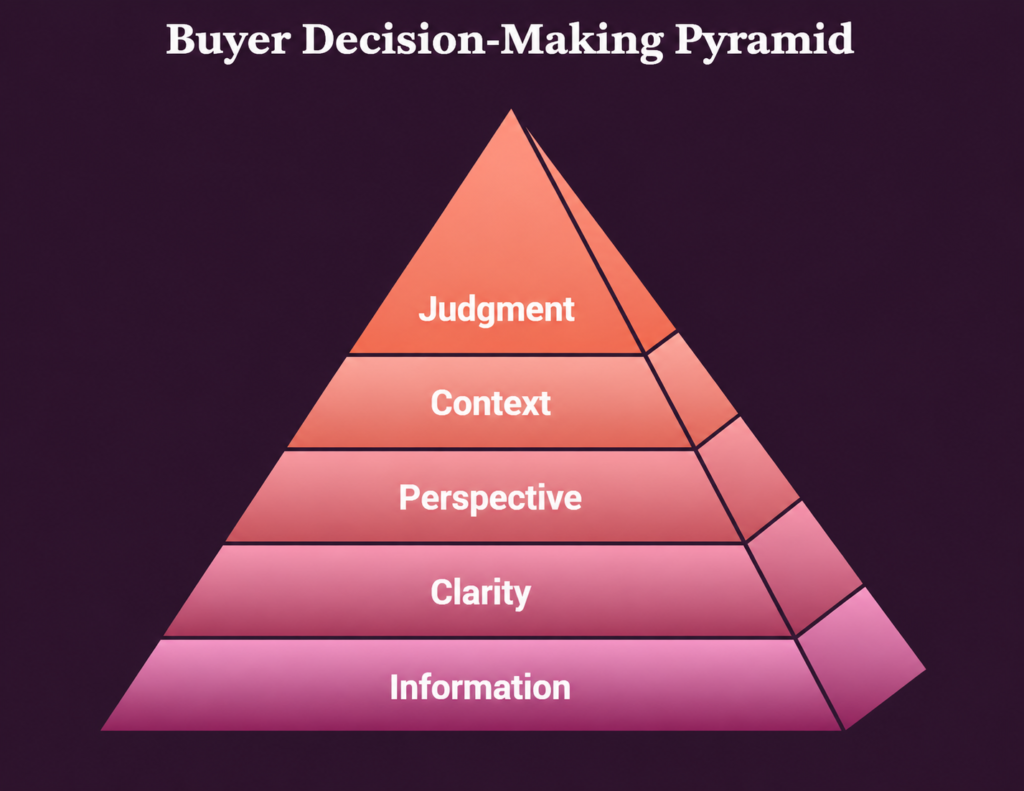
Information is available everywhere.
Judgment is not.
The most valuable sales conversations move buyers upward – from information gathering to decision confidence.
Here are five things that online research still cannot fully reveal.
1. Why the best solution often doesn’t win?
A solution may have:
- Better functionality
- Better commercial value
- Better implementation support
- Better long-term outcomes
And still lose.
Why?
Because decisions are made by people, not spreadsheets.
Different stakeholders often have different priorities:
- Finance evaluates risk
- Operations evaluates disruption
- Procurement evaluates cost
- Business leaders evaluate strategic impact
The challenge is rarely identifying the best solution. The challenge is creating alignment around it.
Strong sales professionals help buyers navigate those internal conversations. Because the biggest obstacle is often not the competition. It is internal consensus.
2. Why buyers delay decisions even after they are convinced?
Every experienced salesperson has seen it.
The meetings go well.
The business case is clear.
The stakeholders are engaged.
And then nothing happens.
The common assumption is, “The buyer needs more information.”
In reality, buyers often need something else.
They need confidence.
There is an important difference between the two.
Information helps people understand.
Confidence helps people act.
Most significant B2B decisions involve questions that never appear in a proposal:
- What happens if this fails?
- How will this affect my credibility?
- Will the organization support this decision?
- Have we considered all the risks?
The issue is not just knowledge; the issue is perceived risk.
The most effective salespeople understand that their role is not simply to provide answers but to help buyers move from understanding to conviction.
3. What similar organizations learned the hard way?
One of the most valuable assets in B2B sales is pattern recognition.
With experience, professionals start spotting the same challenges again and again. They recognize what high-performing organizations do consistently right, and what tends to get overlooked.
Some patterns that show up often:
- Stakeholder alignment is needed sooner than most realize
- Getting people to adopt a solution is tougher than building it
- How you communicate internally can make or break the outcome
- Leadership sponsorship is very essential
These insights are not discovered in reports or data sets. They surface through lived experience. Buyers are not always looking for new ideas.
What clients often need is not more data. They need reassurance that they are not missing a critical blind spot. That reassurance comes from seasoned perspective, not additional information.
4. The questions nobody is asking yet
Research is excellent at answering questions. But great decisions often depend on questions that have not yet been asked.
This is where consultative selling creates disproportionate value.
Strong sales professionals expand the conversation. They encourage buyers to think beyond immediate requirements.
Questions like:
- What will success look like one year from now?
- Which stakeholders are missing from this discussion?
- What behaviors need to change for this initiative to succeed?
- What could prevent adoption?
- How will value actually be measured?
These questions often reveal issues that product comparisons never uncover.
The quality of a decision frequently improves because someone asked a better question.
Not because someone provided a better answer
5. Whether the organization is truly ready?
Many organizations focus heavily on selecting the right solution.
But readiness to execute it well gets less focus.
There is a difference.
A company may have:
- Budget approval
- Executive sponsorship
- Technical capability
- A clear business case
And still struggle.
Why?
Because readiness is not only just operational but also organizational.
Success often depends on factors such as:
- Leadership alignment
- Change readiness
- Capability development
- Stakeholder commitment
- Cultural acceptance
The most effective sales professionals help buyers evaluate both the solution and the conditions required for success.
That perspective can prevent expensive mistakes. And it often creates more value than the product discussion itself.
The real advantage in modern B2B sales
The internet solved the information problem. AI is accelerating that trend even further.
But neither has solved the decision problem.
Buyers today have more information than any generation before them.
What they often lack is:
- Clarity
- Perspective
- Confidence
- Context
- Judgment
At Groval Eulers, we frequently observe that the most successful sales professionals are no longer information providers. They are decision partners. They help customers make sense of complexity, navigate competing priorities, and move forward with greater confidence.
Everyone has access to the same Information now. So the edge doesn’t come from knowing more. It comes from helping your customer see something they had not seen before.
That is the skill that separates good from great in B2B sales.
Reflection for Sales Leaders
As information becomes easier to access, the value of sales is shifting.
The most impactful sales professionals are no longer distinguished by what they know. Rather they are distinguished by how well they help customers think, align, and decide.
Ask yourself:
- Are your sales teams primarily sharing information or shaping decisions?
- How effectively do they help buyers build internal consensus?
- What unique perspective do they bring that a search engine or AI tool cannot?
Ready to elevate your team’s role from information provider to trusted decision partner? Connect with Groval Eulers to explore how we can help.
FAQs
1. If buyers already have information, what value does a salesperson add?
By providing perspective, context, and decision-making confidence.
2. Why do buyers delay decisions after evaluating solutions?
Because confidence, not information, often determines action.
3. What is consultative selling?
Helping buyers think through decisions, not just presenting solutions.
4. What separates top B2B sales professionals today?
Their ability to guide decisions, align stakeholders, and uncover unseen risks.
5. What is the biggest challenge in complex B2B buying decisions?
Aligning stakeholders around a decision, not evaluating options.
