
“The future of sales leadership belongs to those who can influence with clarity, credibility, and confidence.”
Sales leadership is entering a new era.
Today’s customers are more informed, conversations are more complex, and decision-making involves multiple stakeholders across functions. In this environment, technical expertise and sales process knowledge alone are no longer enough to create meaningful influence.
Modern sales leadership increasingly depends on executive presence.
Not the traditional version associated with authority or charisma, but a more evolved capability rooted in strategic thinking, composure, credibility, and the ability to create confidence in critical business conversations.
The strongest sales leaders today are recognized not simply by how they sell, but by how they lead interactions, shape decisions, and build trust across customer relationships.
Executive presence is becoming a leadership differentiator
In modern sales environments, buyers evaluate leaders long before commercial decisions are made.
They observe:
- How leaders respond under pressure?
- How clearly they communicate ideas?
- How confidently they handle ambiguity?
- How thoughtfully they engage stakeholders?
- How effectively they align business value with customer priorities?
Executive presence creates reassurance in moments where complexity, uncertainty, and strategic decisions intersect.
It transforms sales conversations into leadership conversations.
Why modern buyers respond differently today?
The expectations from sales leadership have changed significantly over the last decade.
Customers no longer look only for product knowledge or persuasive presentations. They value leaders who can contribute business perspective, industry understanding, and strategic clarity.
As a result, modern sales leaders are increasingly expected to:
- Lead consultative discussions
- Simplify complex business challenges
- Build cross-functional alignment
- Navigate stakeholder dynamics
- Create long-term partnership confidence
Executive presence enables leaders to elevate conversations beyond transactional selling into strategic business engagement.
The rise of calm and credible leadership
In fast-moving business environments, presence is often revealed during moments of pressure.
Modern sales leaders are expected to manage:
- Competitive market conditions
- Shorter decision cycles
- Digital-first customer engagement
- Revenue pressure
- Internal collaboration challenges
Leaders who demonstrate calmness, clarity, and decisiveness during uncertainty naturally create stronger trust among customers and teams.
This is why executive presence is increasingly associated with emotional composure rather than dominance.
The ability to remain grounded while guiding important conversations has become a defining leadership strength.
Executive Presence in the Digital Sales Era
The shift toward hybrid and virtual selling has redefined how leadership influence is built.
Today, executive presence is communicated through:
- Virtual customer interactions
- Online presentations
- Strategic review meetings
- Digital communication
- Cross-geography collaboration
Modern sales leaders must learn how to create engagement without relying on physical presence alone.
This requires:
- Concise communication
- Active listening
- Thoughtful questioning
- Structured business storytelling
- Confidence in digital interactions
The leaders who communicate with clarity across digital environments are often perceived as more credible and strategically aligned.
Why human influence matters more in ai-driven sales?
AI is transforming sales enablement, forecasting, prospecting, and customer intelligence. But while technology improves efficiency, executive presence strengthens relationships.
Customers still look for human reassurance in high-value decisions.
They remember leaders who:
- Listen carefully
- Understand business realities
- Bring clarity to complexity
- Communicate with confidence
- Create thoughtful strategic dialogue
As automation increases, human-centered leadership is becoming even more valuable.
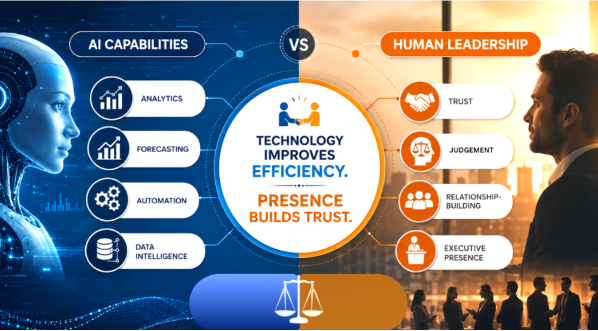
Executive presence is now one of the most important ways sales leaders differentiate themselves in increasingly technology-enabled environments.
How Executive Presence shapes Sales Teams ?
Sales teams are deeply influenced by the behavior and mindset of their leaders.
Leaders with strong executive presence often create:
- Greater team confidence
- Stronger accountability
- Better collaboration
- More customer-focused thinking
- Higher-quality sales conversations
Their influence extends beyond targets and metrics. They shape how teams approach customers, handle challenges, and represent the organization.
In many organizations, executive presence becomes part of the sales culture itself.
Developing Executive Presence in Sales Organizations
Executive presence is not a personality trait reserved for a few individuals. It is a capability that can be intentionally developed.
Organizations can strengthen executive presence through:
- Leadership communication development
- Strategic business acumen training
- Coaching and feedback interventions
- Customer conversation simulations
- Stakeholder management capability building
- Emotional intelligence development
The objective is not to create uniform leadership styles, but leaders who can build trust and influence authentically.
The Future of Sales Leadership
The next generation of sales leadership will be defined less by aggressive selling and more by strategic influence.
Organizations will increasingly value leaders who can:
- Inspire confidence during uncertainty
- Lead customer conversations with maturity
- Align people around business outcomes
- Build long-term trust
- Combine commercial intelligence with human insight
Because in modern sales environments, executive presence is no longer a soft skill.
It is becoming a business capability that shapes growth, relationships, and leadership impact.
Build Future-Ready Sales Leadership Capabilities
Organizations looking to strengthen leadership influence, customer engagement, and strategic selling capabilities must invest in developing executive presence across sales teams and leaders.
Groval Euler’s helps organizations build modern sales leadership capabilities through customized interventions focused on executive presence, consultative influence, strategic communication, and customer-centric leadership development.
Explore our sales programs.
Frequently Asked Questions
What is executive presence in sales leadership?
Executive presence in sales leadership refers to the ability to influence with credibility, clarity, confidence, and strategic business understanding across customer and organizational interactions.
Why is executive presence important for sales leaders today?
Modern sales environments require leaders who can manage complexity, influence stakeholders, build customer trust, and lead strategic conversations effectively.
Is executive presence only about communication skills?
No. Communication is only one aspect of executive presence. It also includes emotional composure, business acumen, strategic thinking, leadership maturity, and relationship-building capability.
How does executive presence improve customer engagement?
Sales leaders with strong executive presence often create more trust-based conversations, stronger strategic alignment, and greater confidence among customers and stakeholders.
How can organizations strengthen executive presence in sales teams?
Organizations can develop executive presence through structured leadership development programs focused on strategic influence, consultative engagement, emotional intelligence, and executive-level communication skills.
