
“The difference between good sales teams and great ones is not just effort, it is direction.”
In today’s complex B2B landscape, sales teams face a set of challenges that bear little resemblance to those of a decade ago. Buyers are better informed, competition is relentless, and decision-making cycles are longer and more collaborative. Traditional scripts and one-size-fits-all approaches are no longer enough. Sales leaders and professionals need a framework that not only keeps them steady but also accelerates performance in meaningful ways.
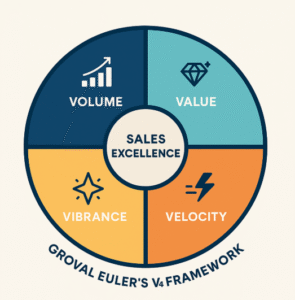
This is where Groval Euler’s V4 model—Volume, Value, Vibrance, and Velocity acts as a compass. It doesn’t just measure what sales teams are doing; it guides them on how to do it better. By applying these four dimensions, organisations can drive consistency, elevate client trust, and unlock sustainable growth.
-
Volume: Building consistent Sales Momentum
Every sales leader knows that without a healthy pipeline, even the most polished sales pitch cannot sustain business growth. Many teams mistake busyness for progress. The real challenge is generating consistent and qualified volume that consistently fuels the funnel.
- This means defining precise prospecting rhythms, ensuring outreach is not sporadic but structured.
- It is not about chasing hundreds of leads; it is about focusing on the right ones that match your value proposition.
- A sales leader must ask: Are we nurturing enough opportunities today to feed tomorrow’s growth?
When applied correctly, the “Volume” dimension shifts teams from reactive selling to proactive pipeline building ensuring no quarter begins with uncertainty.
-
Value: Selling beyond the Transaction
A recurring weakness in many B2B teams is the tendency to sell products instead of solving problems. Buyers today are not looking for vendors; they want partners who add value beyond the contract.
- Value creation means identifying pain points before the client articulates them, and showing how your solutions align with their long-term goals.
- It requires consultative selling, account management culture, and deep client engagement that moves conversations away from discounts and towards impact.
- Leaders should reflect: Are we positioned as trusted advisors, or are we still being perceived as one among many suppliers?
This is where Groval Euler’s philosophy of value-driven growth becomes a differentiator. By embedding this mindset, teams not only win deals but also retain clients for the long term.
-
Vibrance: Bringing Energy and Engagement to Sales conversations
Even with volume and value, many teams fail because their interactions lack vibrance. Sales is more about the energy you bring into the room (or Zoom call). Vibrance is the spark that builds trust and turns conversations into collaborations.
- It is seen in how teams engage stakeholders, use storytelling, and adapt to client energy during interactions.
- Vibrance shows up when salespeople are not just presenters but listeners who make clients feel heard.
- It requires a leadership culture that celebrates creativity, not just compliance with processes.
Are our sales conversations energizing clients, or are they leaving them indifferent?
A vibrant sales culture brand equity in every conversation.
-
Velocity: Accelerating the Sales Cycle without losing depth
In B2B sales, time kills deals. Long decision cycles are common, but they need not always be accepted as the norm. Velocity is about creating the right pace, moving opportunities forward with clarity and urgency.
- This doesn’t mean rushing clients, but removing bottlenecks by aligning stakeholders and addressing objections early.
- Teams should use data, account insights, and clear action steps to ensure progress is visible at every stage.
- Leaders must ask: Are our deals moving forward with purpose, or are they stuck in endless “maybes”?
Velocity brings discipline to execution. It strikes a balance between speed and depth, ensuring that while opportunities move quickly, the client experience remains consultative and thoughtful.
Reflective Checklist for Sales Leaders
As you reflect on the V4 model, here are some questions to challenge your current approach:
- Are we generating consistent, qualified volume in our pipeline?
- Do our clients clearly experience the value we claim to provide?
- Are our sales interactions filled with vibrance that energises decision-makers?
- Are we managing velocity in a way that accelerates deals without putting pressure on clients?
A quick team discussion on these four questions can reveal immediate gaps and opportunities for improvement.
Compass for Growth
The Groval Euler’s V4 model is not just another framework; it is a compass. In the turbulence of B2B sales, it gives leaders and teams a reliable direction for building pipelines, delivering value, energising conversations, and accelerating cycles.
The question for sales leaders today is not whether these four dimensions matter, but:
Which one is your weakest link right now, and how quickly can you strengthen it?
If this topic resonates with your current sales challenges, I would appreciate hearing your thoughts.
Reach out to me at [email protected]
Explore more resources on consultative selling, account management culture, and B2B sales leadership on the Groval Eulers website.
