
“Excellence is not an act, but a habit.” – Aristotle
Sales excellence is not about chasing the next big tactic or the latest tool. It is about building the right mindset, showing up with consistency, and having the willingness to adapt and grow. These three ingredients determine whether a salesperson thrives in the long run or burns out after short bursts of success.
At Groval Eulers, we use a 4-Quadrant Model to explain how these elements interact. This simple yet powerful framework helps sales leaders and professionals understand their current position and identify the necessary shifts to achieve sustainable excellence.
The 4-Quadrant Model of Sales Excellence
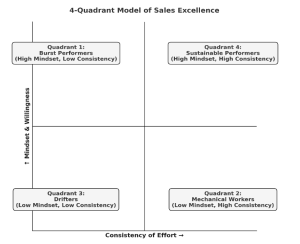
This model maps sales performance on two axes:
- Mindset & Willingness (vertical axis)
- Consistency of Effort (horizontal axis)
The combination of these creates four distinct quadrants:
-
Quadrant 1 – Burst Performers (High Mindset, Low Consistency)
These professionals have the right intentions, creativity, and enthusiasm, but they lack a sense of rhythm. Their energy comes in spurts, brilliant one quarter, invisible the next.
- They inspire with ideas but often miss targets due to a lack of follow-through.
- Customers appreciate their passion but struggle with reliability.
- Without discipline, their potential remains unrealised.
To grow: Build systems, daily sales rhythms, and accountability mechanisms that turn bursts into steady performance.
-
Quadrant 2 – Mechanical Workers (Low Mindset, High Consistency)
These are the disciplined doers who never miss a call log or a CRM update. However, their actions often lack depth, insight, or a customer-centric focus.
- They rely heavily on scripts and routines, missing the “why” behind the “what.”
- Their activity numbers look strong, but their conversion rates remain low.
- Customers may feel that they are being processed rather than understood.
To grow, develop consultative selling skills, cultivate curiosity, and demonstrate a willingness to experiment, pair discipline with mindset shifts.
-
Quadrant 3 – Drifters (Low Mindset, Low Consistency)
This is where sales careers stagnate. With neither the right mindset nor consistent effort, performance is left to chance.
- They often blame market conditions or lack of leads for poor outcomes.
- Confidence dips, and disengagement spreads within teams.
- Sales leaders spend too much time trying to “push” rather than coach.
To grow: Reignite willingness first, help them reconnect with purpose, set achievable habits, and build small wins that restore belief.
-
Quadrant 4 – Sustainable Performers (High Mindset, High Consistency)
This is the sweet spot, where salespeople not only hit targets but also grow customer trust and long-term value.
- They combine discipline with curiosity, persistence with empathy.
- Their customer conversations are consultative, value-driven, and consistent.
- They are coachable, resilient under pressure, and trusted advisors in the eyes of clients.
To grow: Protect and nurture this group. Use them as mentors, champions of culture, and role models across the sales organization.
Why this Model matters?
The 4-Quadrant Model highlights a truth many sales leaders overlook: skills and tools are important, but without mindset, consistency, and willingness, they cannot be sustained. Transformation happens when individuals move quadrant by quadrant toward Quadrant 4.
As leaders, we must ask ourselves:
- Are we rewarding only activity, or also mindset and growth?
- Do our rhythms support consistency, or do they encourage firefighting?
- How often do we coach willingness, not just skills?
Reflective Checklist
Before you close this article, take a moment to assess your team and yourself:
- Where would you place most of your team members in the 4-Quadrant Model?
- What small shifts in mindset or consistency could help them move forward?
- How are you personally modelling Quadrant 4 behaviours as a leader?
Sales excellence is not a one-time win, it is a culture of discipline, growth, and adaptability. The 4-Quadrant Model gives us a practical lens to see where we are and where we need to go.
The choice is simple: stay in cycles of short bursts and stagnation, or build a foundation of sustainable performance that compounds over time.
So, where do you and your team stand today? And more importantly, where do you want to be tomorrow?
Reach out to me at [email protected]
Explore more insights on consultative selling, account management culture, and sales leadership at grovaleulers.com
