The Evolution of Sales Conversations has already begun
B2B sales conversations in 2026 look very different from what they did even a few years ago.
Buyers are more informed. Decision cycles are more complex. Attention spans are shorter. And artificial intelligence is reshaping how sales teams prepare, engage, analyse, and follow up.
But despite all the technological advancement, one reality remains unchanged:
People still buy from people they trust.
AI is not replacing sales conversations. It is transforming them.
The organisations that succeed in this new environment are not the ones using the most AI tools. They are the ones using AI to create more relevant, human-centered, and value-driven conversations.
At Groval Eulers, we believe the future of B2B sales lies at the intersection of technology and human capability.
From Transactional Selling to Intelligent Selling
Traditional sales conversations often relied on scripted pitches, repetitive follow-ups, and generic presentations.
Today’s buyers expect something entirely different.
They expect:
- Contextual understanding
- Industry-specific insights
- Faster responses
- Personalised engagement
- Strategic conversations instead of product pitches
AI is enabling sales teams to shift from transactional selling to intelligent selling.
Modern AI-powered platforms can now:
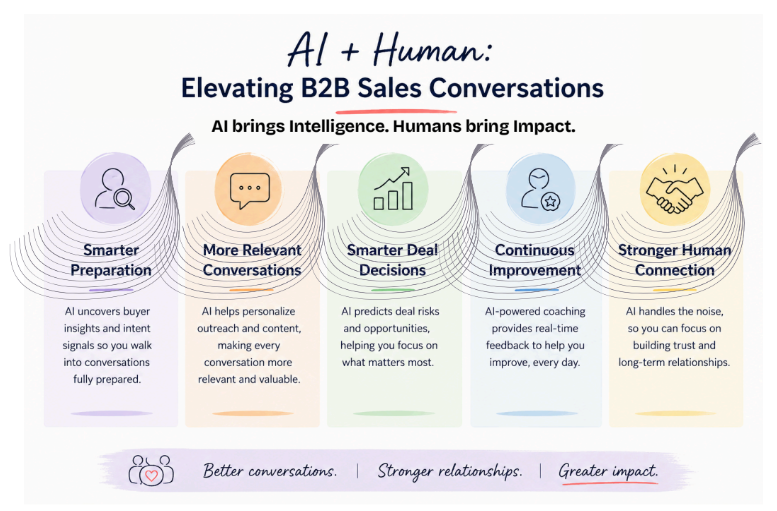
- Analyse buyer intent signals
- Recommend next-best actions
- Summarise customer interactions
- Generate personalised outreach
- Predict deal risks
- Provide real-time coaching during conversations
This allows sales professionals to spend less time on administrative work and more time building meaningful client relationships.
AI Is Changing How Sales Teams Prepare
Preparation has always been one of the most important aspects of successful selling.
In 2026, AI is making preparation faster, deeper, and more strategic.
Before a meeting even begins, AI tools can help sales teams:
- Research company priorities
- Identify key decision-makers
- Analyse previous interactions
- Understand market trends
- Anticipate customer concerns
- Generate tailored conversation frameworks
Instead of entering meetings with generic presentations, sales professionals can now engage with sharper insights and stronger relevance.
The result is a more consultative and valuable customer experience.
Sales conversations are becoming more personalised
One of the biggest shifts AI has enabled is hyper-personalisation at scale.
Buyers no longer respond to broad messaging.
They respond to conversations that reflect:
- Their business priorities
- Their industry realities
- Their growth challenges
- Their organisational goals
AI helps sales teams personalise communication without losing speed or efficiency.
From customised email sequences to tailored proposal recommendations, AI enables organisations to create conversations that feel more relevant and timely.
However, personalisation alone is not enough.
Customers can quickly identify communication that feels automated or impersonal.
This is why emotional intelligence, empathy, and listening skills are becoming even more important in the AI era.
The Rise of AI-Assisted Sales Coaching
Sales coaching is undergoing a major transformation.
Traditionally, coaching depended heavily on manual observation, manager experience, and periodic reviews.
Today, AI-enabled coaching platforms can:
- Analyse sales calls in real time
- Identify conversation patterns
- Evaluate questioning techniques
- Measure talk-to-listen ratios
- Detect customer sentiment
- Recommend improvement areas
This creates continuous learning opportunities for sales teams.
Instead of waiting for quarterly feedback, sales professionals receive immediate developmental insights that help them improve faster.
For sales leaders, this also creates greater visibility into team capability development and performance consistency.
Human Skills are becoming the real competitive advantage
As AI automates repetitive sales activities, uniquely human capabilities are becoming more valuable.
In 2026, the most effective sales professionals are not necessarily the ones with the most product knowledge.
They are the ones who can:
- Build trust
- Ask meaningful questions
- Navigate complex stakeholder dynamics
- Demonstrate empathy
- Think strategically
- Facilitate decision-making
- Communicate with authenticity
AI can generate information. But it cannot replace genuine human connection. This is why organisations must focus not only on digital transformation but also on human capability transformation.
The future belongs to sales teams that combine technological intelligence with emotional intelligence.
Buyers expect Insight-Led Conversations
Modern buyers are overwhelmed with information.
They are not looking for more pitches. Rather, they are looking for clarity, perspective, and strategic value.
AI gives sales teams access to enormous amounts of data. But data alone does not create impact. The real differentiator is the ability to convert information into meaningful business insight.
In 2026, successful B2B sales conversations are increasingly:
- Advisory rather than transactional
- Collaborative rather than persuasive
- Insight-led rather than product-led
Sales professionals must evolve from sellers to trusted business partners.
Challenges organisations must address
While AI creates significant opportunities, it also introduces new challenges.
Many organisations are currently facing:
- AI adoption resistance
- Skill gaps in sales teams
- Overdependence on automation
- Inconsistent use of AI tools
- Reduced human engagement in customer interactions
Without proper capability development, AI can become another disconnected technology initiative rather than a performance enabler.
This is why sales transformation requires more than tools.
It requires:
- Leadership alignment
- Sales capability development
- Coaching culture
- Behavioural reinforcement
- Human-centered learning approaches
The Future of B2B Sales is Human + AI
The conversation around AI in sales should not be framed as humans versus technology. The real opportunity lies in human and AI collaboration.
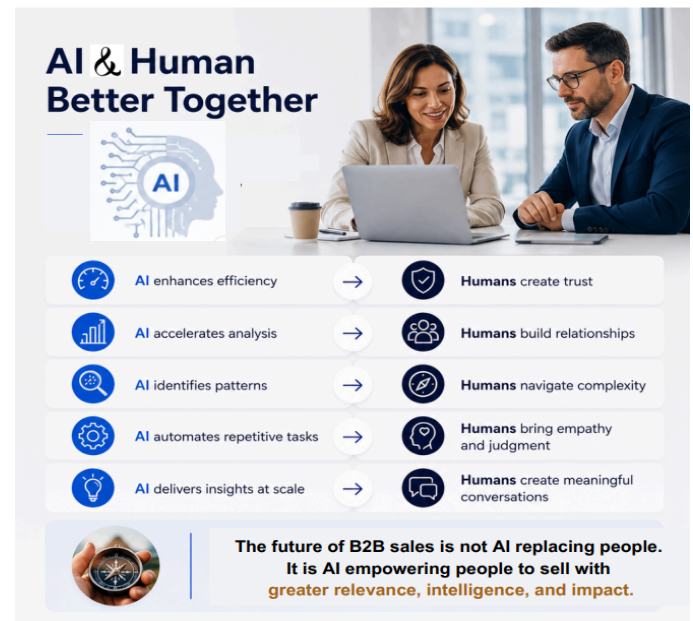
The highest-performing sales organisations in 2026 are the ones building this balance intentionally.
AI is fundamentally changing B2B sales conversations. But the future of sales is not about replacing people with technology. It is about empowering people with better intelligence, deeper insights, and stronger capabilities.
Organisations that invest in both AI adoption and human-centered sales development will be far better positioned to build trust, create value, and drive sustainable growth.
At Groval Eulers, we believe sales excellence in the AI era requires more than digital tools. It requires adaptive learning, consultative capability, coaching culture, and meaningful human connection.
Because even in an AI-powered world, conversations still drive business relationships.
Groval Eulers partners with organisations to build future-ready sales capabilities through experiential learning, sales transformation programs, leadership development, and coaching-led performance enhancement.
