
AI is a force multiplier, not a life support system. If a sales team lacks energy, focus, and discipline, AI will not hide it. It will reveal it.
AI can draft emails, summarize calls, identify buying signals, analyze pipeline risks, and recommend next steps. It can make sales teams faster and more informed. But it cannot create accountability, sharpen leadership, or build a culture of ownership on its own.
A strong sales team with AI becomes stronger.
A disengaged sales team with AI simply becomes faster at repeating ineffective habits.
The future of sales will not belong to organizations that merely adopt AI tools. It will belong to organizations that know how to combine human energy, leadership clarity, and AI-driven intelligence.

That is where real sales transformation begins.
AI does not replace sales leadership. It raises the standard.
AI is changing how sales teams prepare, engage, and execute. But it is not replacing the role of leadership. It is making leadership more visible.
When processes are clear, AI accelerates execution. When managers coach consistently, AI makes coaching sharper. When customer data is reliable, AI improves decision-making.
But weak systems become more exposed in an AI-driven environment.
Messy CRM habits, poor qualification, inconsistent follow-ups, and reactive selling patterns become easier to identify. AI surfaces gaps quickly, but it cannot fix them without strong leadership intervention.
This is why AI adoption should never be treated as just a technology rollout. It is a behavioral and operational shift.
Sales leaders must define how AI fits into the sales process, where it creates value, and what standards teams are expected to maintain. Without that clarity, AI becomes another underused platform instead of a performance advantage.
The organizations that succeed will not necessarily have the most AI tools. They will have the strongest alignment between leadership, process discipline, and team execution.
Remove the energy leaks first:
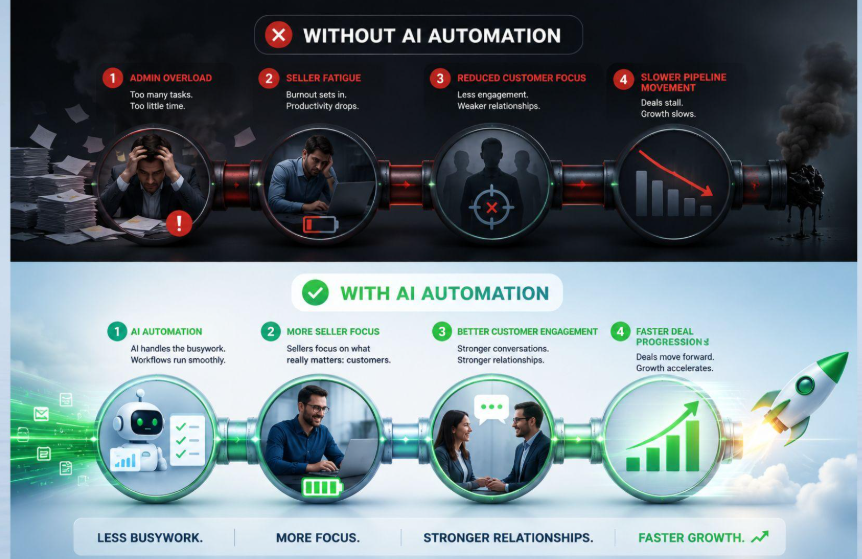
Many sales teams are not lacking talent. They are lacking momentum.
Too much time is lost to repetitive admin work, unclear priorities, inefficient meetings, and scattered prospecting efforts. Sellers become busy without becoming productive. Managers spend more time reviewing dashboards than improving performance.
Over time, these small inefficiencies drain energy from the system.
This is where AI can make a meaningful difference.
AI can reduce manual research, automate summaries, organize follow-ups, identify stalled deals, and surface patterns across objections or customer concerns. It helps leaders identify friction points that slow performance.
The result is not just better productivity. It is better focus.
When sellers spend less time navigating operational clutter, they can spend more time building relationships, understanding customers, and moving opportunities forward.
High-performing sales teams are not energized because they work endlessly. They are energized because they work with clarity.
Build AI into the daily sales rhythm
One of the biggest mistakes organizations make is treating AI as a separate initiative instead of embedding it into everyday sales behavior.
AI adoption does not happen because a company buys a platform or conducts one training session. It happens when AI becomes part of the team’s operating rhythm.
Before prospecting, AI can help identify high-intent accounts and personalize outreach. Before customer meetings, it can support research and conversation preparation. After calls, it can summarize insights, capture commitments, and recommend next steps. During pipeline reviews, it can help leaders spot risks and prioritize action.
When AI becomes integrated into the daily flow of selling, adoption feels natural instead of forced.
Sales leaders play a critical role here. They must define where AI should support the process and where human judgment remains essential.
The goal is not to automate selling. The goal is to help sellers spend more time doing meaningful selling work.
Managers must become the AI adoption engine
The success of AI in sales depends heavily on managers.
If managers do not actively use AI in coaching and pipeline conversations, adoption across the team will remain inconsistent. Sellers take behavioral cues from leadership. When managers treat AI as valuable, teams are far more likely to see it the same way.
AI can help managers identify recurring objections, weak discovery conversations, deal stagnation, and inconsistent follow-up quality. But insights alone do not improve performance. Coaching does.
The best sales managers will use AI to make coaching more precise and actionable.
Instead of broad advice like “improve your discovery,” managers can coach around specific patterns: weak questioning, unclear value articulation, missing stakeholder engagement, or ineffective urgency creation.
This creates a major shift in sales leadership.
Less generic feedback.
More evidence-based coaching.
Less activity inspection.
More performance improvement.
Managers who know how to combine AI insights with human coaching will become a significant competitive advantage for their organizations.
Train teams for judgment, not just tool usage
AI can generate impressive outputs quickly, but speed does not always equal quality.
Sales teams still need strong commercial judgment.
They need to know whether AI-generated messaging actually sounds relevant, whether recommendations align with customer context, and whether suggested next steps make strategic sense.
This is why AI training cannot stop at prompts and workflows.
Teams must learn how to evaluate AI outputs critically, refine them intelligently, and apply human insight where needed. Sellers who blindly rely on AI risk sounding generic and disconnected from customer realities.
The strongest AI-enabled salespeople will not be the ones who automate the most. They will be the ones who combine technology with strong communication, business understanding, and emotional intelligence.
AI should sharpen human capability, not replace it.
Personalization still needs a Human Voice
Buyers today are overwhelmed with automated outreach.
Generic AI-generated messaging has made personalization harder, not easier. Customers can immediately recognize communication that feels mass-produced or disconnected from their reality.
This creates an important opportunity for sales leaders.
AI should help teams become more informed, not more robotic.
It can help sellers understand industry trends, company priorities, and customer challenges faster. But sellers still need to translate that information into meaningful conversations and relevant perspectives.
Strong personalization is not about inserting a prospect’s name into a template. It is about demonstrating understanding.
The sales teams that stand out in the AI era will be the ones that sound informed, specific, and human – even while operating at scale.
That balance matters.
Replace busy work with Intelligent Action
Many sales organizations still equate performance with volume.
More emails. More calls. More meetings. More reporting.
But activity without direction creates exhaustion.
AI gives sales leaders an opportunity to redesign how teams prioritize effort. Instead of asking sellers to do more of everything, leaders can help them focus on the actions most likely to create momentum.
AI can identify high-intent prospects, highlight deal risks, detect engagement patterns, and recommend where attention should go next. This allows teams to spend energy where it matters most.
The strongest sales organizations in the AI era will not simply move faster. They will move smarter.
Clarity will become a competitive advantage.
Teams that understand where to focus, when to engage, and how to respond with relevance will outperform teams that rely purely on activity volume.
Build trust before expecting adoption
AI adoption is not only a technology challenge. It is a trust challenge.
If salespeople believe AI is being used primarily for monitoring, resistance will increase. If they see AI as a tool that genuinely supports performance and reduces friction, adoption becomes easier.
Sales leaders must shape that narrative carefully.
Teams need clarity around how AI will be used, what expectations exist, and where human oversight matters. They also need confidence that technology is there to improve performance rather than replace human value.
Trust grows when leaders position AI as an enabler of better preparation, stronger coaching, and smarter execution.
Once that trust is established, teams become far more open to experimentation, learning, and adoption.
The real sales advantage is human energy plus AI intelligence
AI will continue reshaping sales organizations. But technology alone will not define the winners.
The real advantage comes from combining human capability with AI-driven intelligence.
- Human curiosity strengthened by AI insights.
- Human judgment supported by better data.
- Human coaching improved by real-time analysis.
- Human relationships enhanced by stronger preparation.
This is the future of sales leadership.
Not AI replacing people.
Not people resisting AI.
But energized, adaptable teams learning how to use technology with confidence and purpose.
The organizations that succeed will not simply automate faster. They will build cultures that can think sharper, adapt quicker, and execute better.
AI can accelerate performance.
Leadership determines the direction.
Ready to build an AI-Enabled sales team that performs?
At Groval Eulers, we help organizations strengthen sales leadership, energize teams, and build future-ready sales capabilities.
As AI continues to reshape selling, organizations need more than tools. They need leaders who can create clarity, alignment, and high-performance execution.
Build a sales team that does not just use AI, build one that wins with it.
Connect with Groval Eulers to create a sharper, more energized, AI-enabled sales engine.
FAQs
1. How can AI improve sales team performance?
AI helps sales teams reduce repetitive tasks, improve preparation, identify deal risks, and personalize customer engagement more effectively. This allows sellers to focus more on relationship-building and strategic selling.
2. Will AI replace salespeople?
AI will not replace strong salespeople. It will increase expectations around preparation, responsiveness, and customer understanding. Human connection, trust, and judgment will remain critical in sales success.
3. What is the biggest mistake companies make with AI in sales?
Many organizations treat AI as a software rollout instead of a leadership and behavior shift. Without clear processes, coaching, and team adoption, AI often becomes underutilized.
4. How can sales managers use AI effectively?
Managers can use AI to identify coaching opportunities, review sales conversations, detect pipeline risks, and improve forecast visibility. This enables more targeted and evidence-based coaching.
5. Why is energy important in AI-enabled sales teams?
AI improves performance best when teams already have clarity, discipline, and motivation. Energized teams use AI to sharpen execution, while disengaged teams often struggle to gain meaningful value from it.
